The best filming locations in Spain have made the country one of the most sought-after film destinations in Europe. This country offers exceptional geographical diversity within relatively short distances. This versatility allows international productions to recreate multiple environments without intercontinental travel, optimising budgets and production times. The country has hosted major productions such as Game of Thrones, Star Wars, Indiana Jones, The Crown, and numerous series for global platforms, consolidating its reputation as a destination that combines visual quality, professional infrastructure, and competitive tax incentives.
Why Spain offers exceptional filming locations
Spain offers virtually every type of cinematic landscape imaginable within an accessible territory. The Spanish geography includes the only authentic European desert, coastlines ranging from Caribbean beaches to dramatic cliffs in the north, mountain ranges with peaks over 3,000 metres high, Atlantic rainforests, unique volcanic landscapes, and cities that preserve architecture from Roman times to the contemporary avant-garde.
This diversity is complemented by a favourable climate that allows filming throughout most of the year, especially in southern regions and archipelagos where there are over 300 hours of sunshine annually. The professional production infrastructure includes more than 48 Film Commissions coordinated by the Spain Film Commission, which facilitate permits, connect with local suppliers, and advise on regional logistics.
The proven track record of the Spanish industry working with top-level international productions guarantees professionalism and efficiency. Spanish technical teams are proficient in international standards, familiar with major studio protocols and capable of operating in multiple languages.
Desert filming locations
Spain is home to desert locations that have defined entire film genres and continue to attract productions seeking arid, otherworldly landscapes.
Desierto de Tabernas (Almería)
The Tabernas Desert in Almería is the only true desert in Europe, with an arid landscape of ochre tones and extraordinary geological formations. This desert achieved international fame during the 1960s and 1970s as the setting for classic spaghetti westerns: The Good, the Bad and the Ugly (Sergio Leone, 1966), A Fistful of Dollars, and For a Few Dollars More established this landscape as iconic of the western genre.
More recently, the desert has been used for science fiction and adventure productions that require extraterrestrial or post-apocalyptic settings. Indiana Jones and the Temple of Doom, Conan the Barbarian, and episodes of Doctor Who all used these locations. The versatility of the landscape allows for recreations ranging from the Middle East to alien planets.
Bardenas Reales (Navarra)
The Bardenas Reales offer a semi-desert landscape with spectacular geological formations: fairy chimneys, eroded plateaus, and white clay ravines that create a unique lunar atmosphere. Game of Thrones used the Bardenas to represent the Dothraki Sea in multiple episodes, taking advantage of its strange and desolate appearance.
Mountain and high-altitude locations
Los sistemas montañosos españoles proporcionan desde picos alpinos nevados hasta formaciones rocosas dramáticas y valles boscosos de montaña.
The Spanish mountain ranges offer everything from snow-capped alpine peaks to dramatic rock formations and wooded mountain valleys.
- The Pyrenees (Aragon, Catalonia, Navarre) offer alpine landscapes with peaks over 3,000 metres, glaciers, high mountain lakes, and dense forests. The Aran Valley and Ordesa National Park have been used for productions requiring authentic mountain settings. The Hunter’s Prayer shot action sequences in Pyrenean landscapes.
- Sierra Nevada (Andalusia) combines the highest altitudes on the Iberian Peninsula with proximity to the Mediterranean, allowing snow and beach scenes to be shot on the same day. The Sierra Nevada ski resort and high mountain areas offer snowy landscapes even in spring.
- Picos de Europa (Asturias, Cantabria, León) features spectacular limestone formations, deep gorges, and lush vegetation. Its dramatic and wild appearance has attracted productions seeking imposing mountains with a humid Atlantic character different from the Pyrenees.
Coastal and beach locations
La diversidad de costas españolas permite recrear lugares como el Caribe o paisajes atlánticos rocosos, cubriendo más de 8.000 kilómetros de litoral.
- The beaches of Cadiz offer white sand and turquoise waters that have doubled as Caribbean locations. La Caleta Beach in Cadiz appeared in Die Another Day (2002), while the beaches of Tarifa and Bolonia provide impressive dunes and views towards Africa. Alatriste (2006) used these coasts for period sequences.
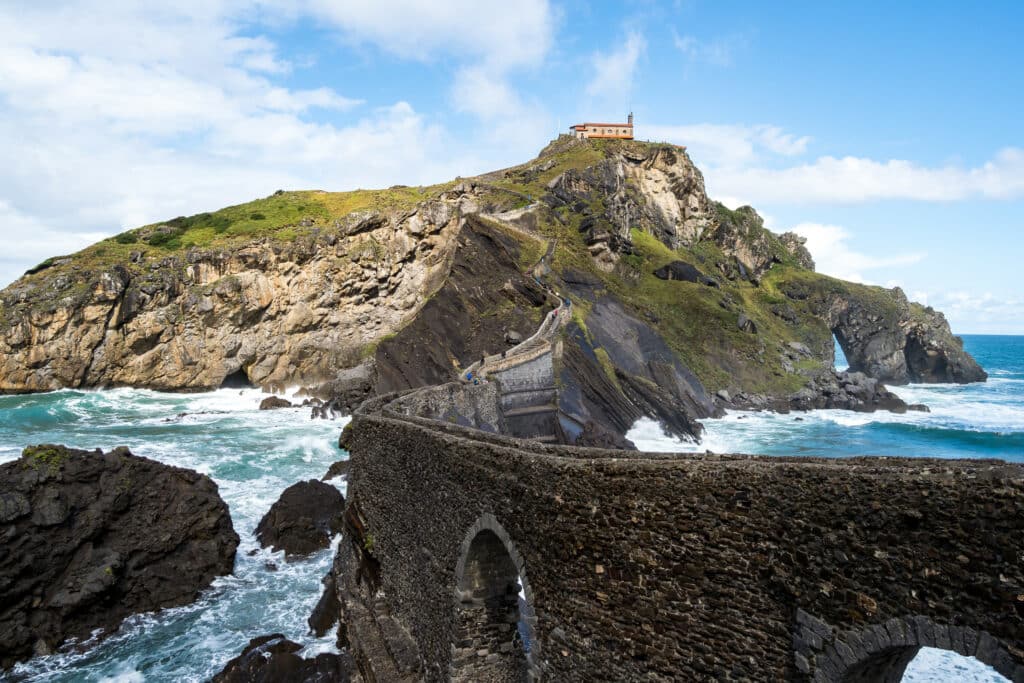
- The Basque Country offers a radically different coastline: dramatic cliffs, imposing rock formations, and rough seas. San Juan de Gaztelugatxe, with its iconic staircase leading to the chapel on the islet, served as Dragonstone in Game of Thrones, becoming one of the most photographed locations in the series.
- The Canary Islands provide filming locations on islands with unique volcanic landscapes, black sand beaches, and a stable subtropical climate all year round. Tenerife, with Mount Teide (Spain’s highest active volcano), has been used for Clash of the Titans (2010) and Fast & Furious 6. Lanzarote, with its lava fields and lunar landscapes, appeared in Almodóvar’s Broken Embraces.
- The Balearic Islands (Mallorca, Menorca, Ibiza, Formentera) offer Mediterranean coastlines with crystal-clear coves, cliffs, and traditional Mediterranean architecture. Mallorca has hosted The Night Manager and multiple British and German productions.
Urban filming locations
Spanish cities provide urban diversity ranging from medieval architecture to contemporary avant-garde, offering exceptional versatility for any script.
- Madrid serves as Spain’s most versatile urban set: grand boulevards, historic buildings, modern architecture, and proximity to rural filming locations. Gran Vía and Plaza de España have appeared in The Bourne Ultimatum and Assassin’s Creed. The financial district offers modern corporate aesthetics, while historic neighbourhoods such as La Latina provide cobbled streets and traditional squares.
- Barcelona stands out for its unique aesthetic dominated by Gaudí’s modernist architecture. The Sagrada Familia, Park Güell, and Paseo de Gracia create a distinctive visual atmosphere used in Vicky Cristina Barcelona, The Passenger, and Perfume: The Story of a Murderer. The Gothic Quarter offers perfectly preserved medieval streets.
- Valencia presents the City of Arts and Sciences, a futuristic complex designed by Santiago Calatrava that has been used to recreate sci-fi settings in Westworld, Andor, and Tomorrowland. Valencia’s historic centre offers medieval and Renaissance architecture.
- Seville combines spectacular Mudejar architecture with narrow streets full of Andalusian character. The Reales Alcázares served as the palace of Dorne in Game of Thrones, while the Plaza de España appeared in Star Wars: Episode II – Attack of the Clones and The Dictator.
Historic and architectural locations
Spain preserves exceptional historical heritage that lends authenticity to period productions without the need for costly sets.
The Alcázar of Segovia, with its fairytale silhouette, inspired Disney’s castle and has appeared in numerous productions. The Alhambra in Granada offers unique Nasrid architecture, with courtyards, fountains, and detailed Islamic decoration. The old town of Girona was used extensively for Game of Thrones (King’s Landing, Braavos), with its medieval streets and perfectly preserved Roman walls.
Toledo provides a complete medieval city with walls, a fortress, a Gothic cathedral, and narrow streets that seem frozen in time. Cáceres, a World Heritage Site, maintains intact medieval and Renaissance architecture, used in Game of Thrones (Riverrun) and multiple period series.
Natural and forest environments
Beyond deserts and mountains, Spain offers diverse forests and natural environments that recreate everything from rainforests to magical beech forests.
The Otzarreta Beech Forest (Basque Country) features centuries-old beech trees with twisted shapes that create a fairytale atmosphere, used for productions that require enchanted forests. The forests of the Baztán Valley (Navarre) offer dense, humid Atlantic vegetation, contrasting with the semi-desert landscapes of the Bardenas in the same region.
Doñana National Park (Andalusia) contains marshes, dunes, and Mediterranean forest, providing unique ecosystems. The Galician fragas feature humid Atlantic forests with mosses, ferns, and rivers that create a mysterious atmosphere ideal for thrillers or fantasy.
Choosing the right filming location
Selecting the appropriate location requires balancing creative needs with practical production considerations.
- Adapting landscapes to the narrative: The primary criterion is to find the perfect visual look. Use this guide to map needs against what each region offers, considering not only the main landscape but also nearby complementary locations.
- Seasonality and climate: Research weather conditions during your shooting period. Southern Spain and the Canary Islands guarantee sunshine practically all year round, while the north offers more greenery but a higher probability of rain. Mountains require careful planning with regard to snow depending on the season.
- Local infrastructure and services: Assess the availability of production professionals, equipment rental suppliers, and support services in the region. Madrid and Barcelona have the most resources, but other regions offer competitive solutions with local film commissions facilitating connections.
- Permits and regional film offices: The efficiency of obtaining permits varies. Consult with the Spain Film Commission and regional offices, which will assist in managing shoots in their respective jurisdictions, facilitating permits, coordinating with local authorities, and resolving logistical challenges.
Production support available through Spain Film Commission
At Spain Film Commission, we facilitate access to the best filming locations in Spain. We coordinate with the 48 regional film commissions to identify locations that meet the specific requirements of each project. We organise tech scouts, connecting production teams with local authorities and location owners. In addition, Spain Film Commission has useful tools, such as AI location search, which will make it much easier for you to begin your adventure.
We manage permits in coordination with municipal and regional authorities and private landowners. We provide contacts with local production service providers, from equipment hire to specialised catering. We advise on available tax incentives and how to maximise their use by combining studio filming with outdoor locations.
Our goal is for international productions to take full advantage of Spain’s geographical diversity, optimising both visual quality and operational and budgetary efficiency.