The television licensing system in Spain is a complex framework that balances the protection of intellectual property rights, the regulation of the audiovisual market, and the promotion of European production. For international production companies and distributors wishing to operate in the Spanish market, understanding this regulatory framework is essential. Spain has significantly modernised its audiovisual legislation in recent years, adapting to the reality of digital platforms and establishing new obligations for both traditional operators and streaming services. This article outlines the essential aspects of audiovisual content licensing in Spain, from the legal basis to the practical procedures for managing rights and complying with regulatory obligations.
Understanding TV licensing and broadcasting regulation
The concept of licensing in the audiovisual sector encompasses both administrative authorisations to operate communication services and the management of content distribution rights. These two aspects, although related, operate in different areas of the audiovisual ecosystem.
What TV licensing means in the audiovisual industry
In the Spanish audiovisual industry, the term ‘licensing’ has two main meanings. First, it refers to administrative licences that authorise an entity to operate broadcasting or audiovisual communication services. These licences, regulated by broadcasting regulations, establish the technical, economic and content conditions under which an audiovisual service provider may operate.
Secondly, ‘licensing’ refers to the transfer of rights to exploit audiovisual works. When a television channel or digital platform wishes to broadcast a film or series, it must obtain a licence from the intellectual property rights holder. This licence specifies territories, means of exploitation, duration, and financial compensation.
Differences between broadcasting and content licensing
A broadcasting licence is an administrative authorisation that enables the operation of an audiovisual communication service, whether terrestrial television, satellite, cable or IPTV. It is obtained by the operator from the competent authorities through public tenders or established administrative procedures. This licence does not grant rights over specific content, only the ability to operate the distribution service.
Content licensing, meanwhile, is a contractual agreement between rights holders (producers, distributors, collective management organisations) and operators (channels, platforms). It does not require direct administrative intervention, although it must comply with the legal framework for intellectual property. An operator may have a broadcasting licence but lack content licences to broadcast, and vice versa, a production company may manage content licences without operating broadcasting services.
How licensing applies to films and television series in Spain
In order to broadcast films or series in Spain, operators must negotiate licences with rights holders. In practice, this involves contacting audiovisual distributors representing producers, or collective management organisations that administer rights to extensive catalogues.
The rights authorisation process begins by identifying who owns the rights for the Spanish territory and the specific medium (free-to-air television, pay television, digital platforms). Major networks usually negotiate content packages with national and international distributors, establishing exploitation windows that comply with prior film distribution agreements.
Licence agreements specify the number of broadcasts permitted, time slots, duration of the agreement, and territories covered. For content that includes music, music rights must also be managed, typically through SGAE for composers’ copyright and AIE for performers’ rights.
Spain’s audiovisual law and regulatory framework
The Spanish regulatory framework for audiovisual media has undergone significant changes to adapt to the digital environment. The current Audiovisual Media Services Act lays the foundations for a modern audiovisual sector that balances freedom of expression, protection of minors, promotion of European production, and competition in the market.
The General Audiovisual Communication Law
La Ley 13/2022 de Comunicación Audiovisual, aprobada en julio de 2022, moderniza el marco regulatorio español ampliando su alcance a plataformas digitales y prestadores de servicios de intercambio de vídeos como YouTube o TikTok. Esta normativa reconoce que el consumo audiovisual ha migrado significativamente hacia servicios bajo demanda y redes sociales, requiriendo regulación adaptada a estas realidades.
Law 13/2022 on Audiovisual Communication, passed in July 2022, modernises the Spanish regulatory framework by extending its scope to digital platforms and video-sharing service providers such as YouTube and TikTok. This regulation recognises that audiovisual consumption has shifted significantly towards on-demand services and social media, requiring regulation adapted to these realities.
The law introduces the concept of ‘social influencers,’ regulating those who exceed certain thresholds: more than 1 million followers on a platform or 2 million in total, annual revenue exceeding €300,000, and publication of more than 24 videos per year. These creators must register and comply with advertising transparency obligations, clearly identifying commercial content.
The CNMC, as an independent regulatory body, supervises compliance with audiovisual regulations, audits European programme funding obligations, and ensures competition in the market. Its functions include analysing business mergers in the sector, recommending age rating criteria, and issuing reports on regulatory projects affecting the audiovisual sector.
Who grants broadcasting licences in Spain
Broadcasting licences in Spain are granted through a system of shared powers between the General State Administration and the Autonomous Communities, depending on the geographical scope of the service.
The Ministry for Digital Transformation and Public Administration, through the Secretary of State for Telecommunications and Digital Infrastructure, manages the radio spectrum and grants licences for national coverage services. Major DTT operators obtain their licences through public tenders organised by the central government, which sets technical, economic and content requirements that bidders must meet.
The Autonomous Communities, for their part, have transferred powers to manage broadcasting licences at the regional and local levels. They may allocate FM radio frequencies and digital terrestrial television channels operating within their territory, following public tender procedures established in their respective regulations.
Regulations for private, public and regional broadcasters
Public operators, especially RTVE as a state-owned public service, operate under a specific regime. The RTVE Corporation is entrusted by law with the provision of radio and television services (RNE and TVE) without requiring the same licensing process as private operators. Its funding comes from state contributions and advertising revenue limited by regulations.
Private operators, whether national or regional, must comply with specific licence obligations: European production quotas (at least 30% of broadcasting time must be devoted to European works, and at least 10% to European works by independent producers made in the last five years), advertising limits (12 minutes per clock hour on linear television), and financial contribution to the advance financing of European audiovisual works (5% of revenue for television operators, 5% for on-demand platforms).
Regional television stations, although operating within limited territorial areas, must comply with the same general obligations regarding the promotion of European works and accessibility, in addition to specific commitments regarding the use of co-official languages in their respective communities.
Rights and licensing management in Spain
Audiovisual rights management in Spain is organised through an ecosystem that combines direct negotiation between rights holders and exploiters with the intermediation of collective management organisations that facilitate access to extensive catalogues.
How content licensing works in Spain
Licensing audiovisual content requires first identifying the rights holder for the Spanish territory. Large audiovisual distributors represent both national and international producers, managing exploitation rights in different windows and territories. Companies such as Avalon, Premium Cine and Karma Films distribute specific catalogues and negotiate licences for television broadcasting directly.
Collective management organisations facilitate access to works whose rights they administer. EGEDA (Audiovisual Producers’ Rights Management Organisation) represents producers, while SGAE (General Society of Authors and Publishers) administers the rights of authors, directors and screenwriters. DAMA (Audiovisual Media Copyright) manages rights for certain groups of authors. These entities allow operators to access extensive catalogues through framework agreements without negotiating work by work.
Managing film and TV rights across platforms
Managing rights across multiple platforms requires contractual clarity regarding exploitation windows. Traditionally, films followed a chronological sequence: cinemas, home video, pay-per-view, pay television, and finally free-to-air television. Digital platforms have altered these patterns, often negotiating exclusivity deals that bypass traditional windows.
Contemporary contracts specify precisely which rights are transferred:
- Linear television (free-to-air or pay TV)
- Transactional on-demand services (pay-per-view)
- Subscription on-demand services, cinema distribution, physical video, and digital downloads. Each type can be licensed independently, with periods of exclusivity or non-exclusivity depending on the negotiation.
Streaming, on-demand and multi-territory exploitation
Streaming platforms typically operate with multi-territory licences, although Spain is a specific market where rights must be obtained for the Spanish territory. Netflix, Amazon Prime Video, Disney+ and other platforms negotiate global licences with international producers or distributors, but they also acquire Spanish content through agreements with local production companies.
Multi-territory exploitation presents complexities when works include elements covered by specific territorial rights: dubbing, subtitles, music. A platform that wants to exploit a Spanish film in Latin America must ensure that its licence covers those territories and that related rights (dubbing, subtitling) are properly managed.
Music and other creative rights in licensed content
Audiovisual content incorporates multiple layers of rights that must be managed individually: rights to the audiovisual work itself, music rights (composition and performance), image rights of actors, and sometimes rights to pre-existing elements included in the work.
How to license music for film and television
Music in audiovisual productions generates dual rights: copyright on the musical composition and lyrics (managed by SGAE in Spain) and performers’ rights on the specific recording (managed by AIE – Artistas Intérpretes o Ejecutantes). Licensing music for audiovisual use requires obtaining both types of rights.
For pre-existing music that is to be included in a production, the audiovisual producer negotiates with the music publisher (who represents the composer) and with the record label (which owns the rights to the master recording). SGAE facilitates certain uses through general licences, but specific synchronisations in audiovisual media usually require direct negotiation.
Original music composed specifically for a production is managed through commissioning contracts that establish the transfer of rights from the composer to the audiovisual producer. These contracts specify territories, means of exploitation, and remuneration, which may be a one-off payment (buy-out) or royalties derived from future exploitation.
Managing creative rights in Spain
Beyond music, other creative contributions generate rights that must be managed. Screenwriters, cinematographers, editors, and art directors own copyrights to their creative contributions to audiovisual works. Spanish law establishes that, unless otherwise agreed, these rights are presumed to be transferred to the producer for the exploitation of the work, but the producer must formalise explicit transfers through contracts.
Actors have image rights that they authorise through artistic service contracts. These contracts specify permitted uses of their image, territories, and media. Uses not covered in the original contract (e.g., using images from the film in merchandising) require additional authorisations and potentially additional payments.
How to clear copyrighted material for broadcast
The process of authorising rights for television broadcasting involves verifying that all necessary rights have been obtained for each element of the work. This includes the main audiovisual work, all musical compositions included, archive images if any, visible trademarks or logos that require authorisation, and any other elements protected by copyright or related rights.
Television channels and platforms have legal departments specialising in rights clearance that review each production before broadcast, identifying elements that require additional licences. This preventive process avoids subsequent claims for unauthorised use that could result in significant financial penalties and content removal.
TV licensing fees and obligations
Audiovisual operators in Spain face multiple financial obligations arising from both their operating licence and sector regulations promoting European production. On the other hand, there are tax incentives for audiovisual productions that could help alleviate the burden of the initial investment in your project.
Administrative fees and broadcaster responsibilities
The initial acquisition of broadcasting licences entails administrative fees that vary according to the type of service and coverage. These fees offset the administrative costs of the tender and award process. In addition, operators must pay annual fees for the use of the radio spectrum, calculated according to the technical parameters of their transmissions (power, coverage, bands used).
Private television operators face specific accessibility obligations: subtitling for deaf people in at least 80% of free-to-air television programming, sign language in certain time slots, and audio description for blind people. The implementation of these measures generates operating costs that operators must bear as part of their public service responsibilities.
Funding obligations for European and Spanish works
Spanish regulations, in line with European directives, establish obligations for the advance financing of European audiovisual works. Audiovisual communication service providers must allocate at least 5% of their annual revenue to financing European productions, with specific criteria regarding which works qualify (productions from European countries, with majority participation by European professionals, made by independent producers).
This obligation extends to both linear television operators and subscription or transactional video-on-demand platforms operating in Spain. The CNMC audits compliance with these obligations and may impose penalties on operators who fail to comply. The aim is for the Spanish and European audiovisual sector to benefit financially from the success of platforms operating in the market, reinvesting part of their revenues in new production.
Compliance and penalties for unlicensed broadcasting
The broadcasting of audiovisual content without the necessary licences constitutes a serious or very serious offence under Spanish law. The CNMC and competent regional bodies may impose penalties ranging from thousands to millions of euros depending on the seriousness, repeat nature, and profit obtained by the offender.
The most serious infringements include:
- Operating audiovisual communication services without an administrative licence.
- Broadcasting content without having obtained intellectual property rights.
- Systematically failing to comply with European programme funding obligations.
Penalties may be combined with orders to cease activity and publication of the penalty, causing additional reputational damage to the infringing operator.
International productions and co-licensing agreements
Spain actively participates in the international audiovisual content market both as an exporter of Spanish productions and as a recipient of foreign content. International co-production agreements facilitate these commercial dynamics.
How international broadcasters acquire Spanish content
International channels and platforms interested in Spanish content typically negotiate with distributors specialising in international sales or sales agents representing Spanish producers. Companies such as Filmax, Youplanet Pictures and Beta Film España act as intermediaries, presenting Spanish catalogues in international markets and managing the resulting licences.
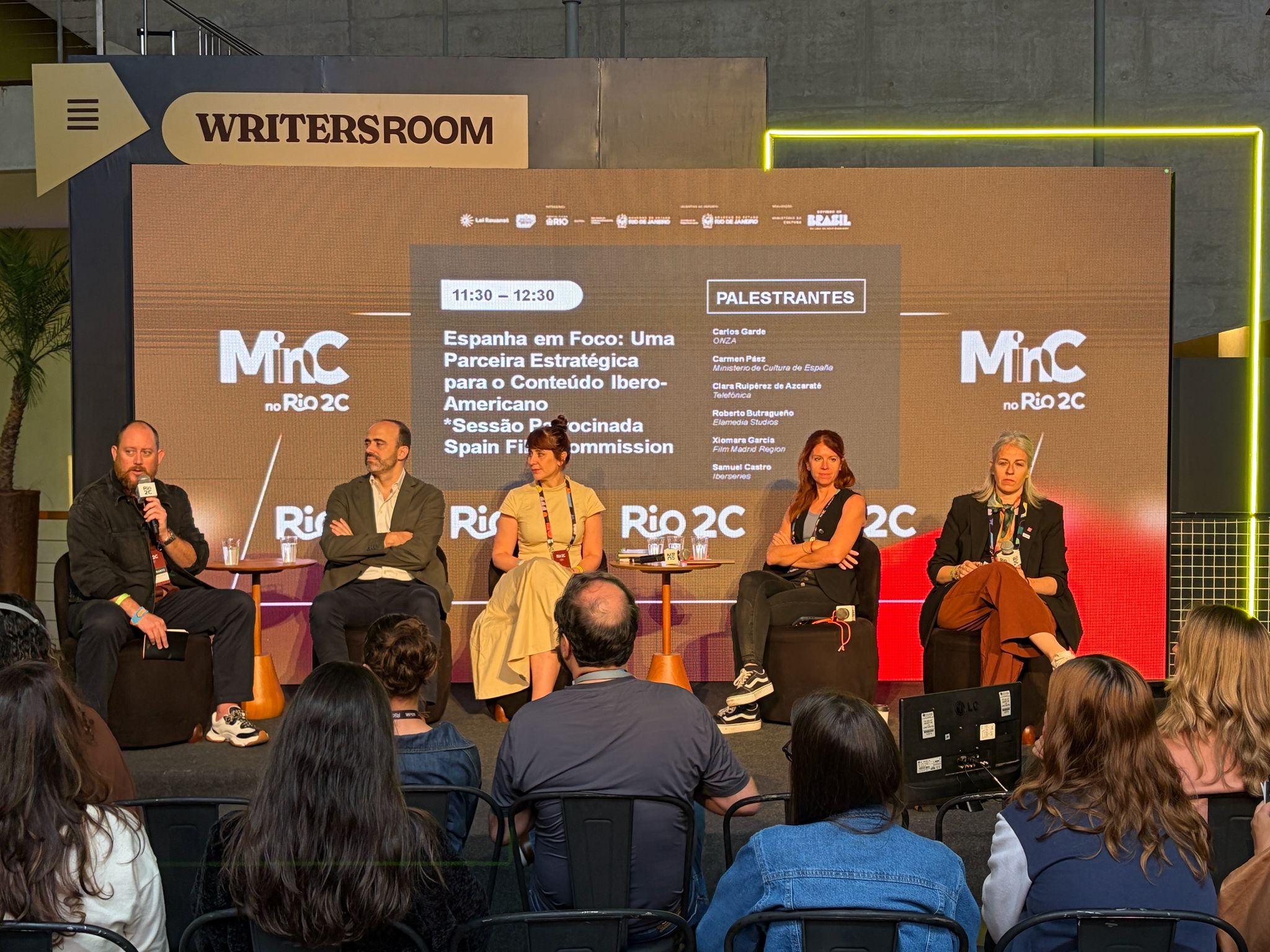
The main international audiovisual markets (MIPCOM, MIP-TV, Series Mania, Berlinale) are venues where Spanish content is promoted to global buyers. Spain Film Commission and Spanish Screenings facilitate the presence of Spanish content at these events, connecting producers with potential international licensees.
Licensing Spanish productions abroad
When a Spanish production is licensed for exploitation in other territories, the contract specifies the territories covered, the means of exploitation (television, streaming, cinemas), authorised languages, and the duration of the licence. The Spanish producer or distributor typically retains rights for the Spanish territory and some Spanish-speaking Latin American markets, licensing other territories separately.
Exploitation windows vary by territory: a series may be available on Netflix in the United States while being broadcast on free-to-air television in Spain, depending on how territorial licences have been structured. This territorial fragmentation, while allowing for maximised revenue, requires complex management to avoid rights conflicts.
How co-production and rights-sharing work in Spain
International co-productions, involving producers from different countries, require carefully negotiated rights structures. Co-production agreements establish which co-producer owns rights in which territories, how exploitation revenues are shared, and what obligations each party assumes.
Spain has co-production treaties with numerous countries that facilitate these collaborations by establishing clear legal frameworks.
Co-productions usually stipulate that each co-producer freely exploits the work in its territory, sharing income from neutral territories according to participation percentages. For important markets such as the United States or Asia, rights are negotiated specifically, distributing income as agreed in the co-production contract.
Working within Spain’s audiovisual licensing ecosystem
Navigating the audiovisual licensing ecosystem in Spain requires understanding both the legal and practical aspects of rights management and commercial relationships with multiple players in the sector.
At Spain Film Commission, we facilitate access to the Spanish audiovisual market for international production companies and distributors. We provide contacts with distributors, collective management organisations, and legal advisors specialising in audiovisual intellectual property. Our knowledge of the Spanish regulatory framework allows us to advise on specific obligations depending on the type of exploitation planned.
We advise on structuring co-productions that optimise access to tax incentives and meet the requirements to qualify as European works. We coordinate with the ICAA and CNMC when projects require interaction with these regulatory bodies. Our goal is to enable international production companies to operate in Spain with a full understanding of the legal environment and maximising the commercial opportunities offered by one of the most dynamic audiovisual markets in Europe.